Notice: Function WP_Styles::add was called incorrectly. The style with the handle "pods-query-monitor" was enqueued with dependencies that are not registered: query-monitor. Please see Debugging in WordPress for more information. (This message was added in version 6.9.1.) in /home/valveccdevcoza/domains/valve.ccdev.co.za/public_html/wp-includes/functions.php on line 6131

Condenser

Are you looking for a precise control valve for your condenser in the power plant? We have it!

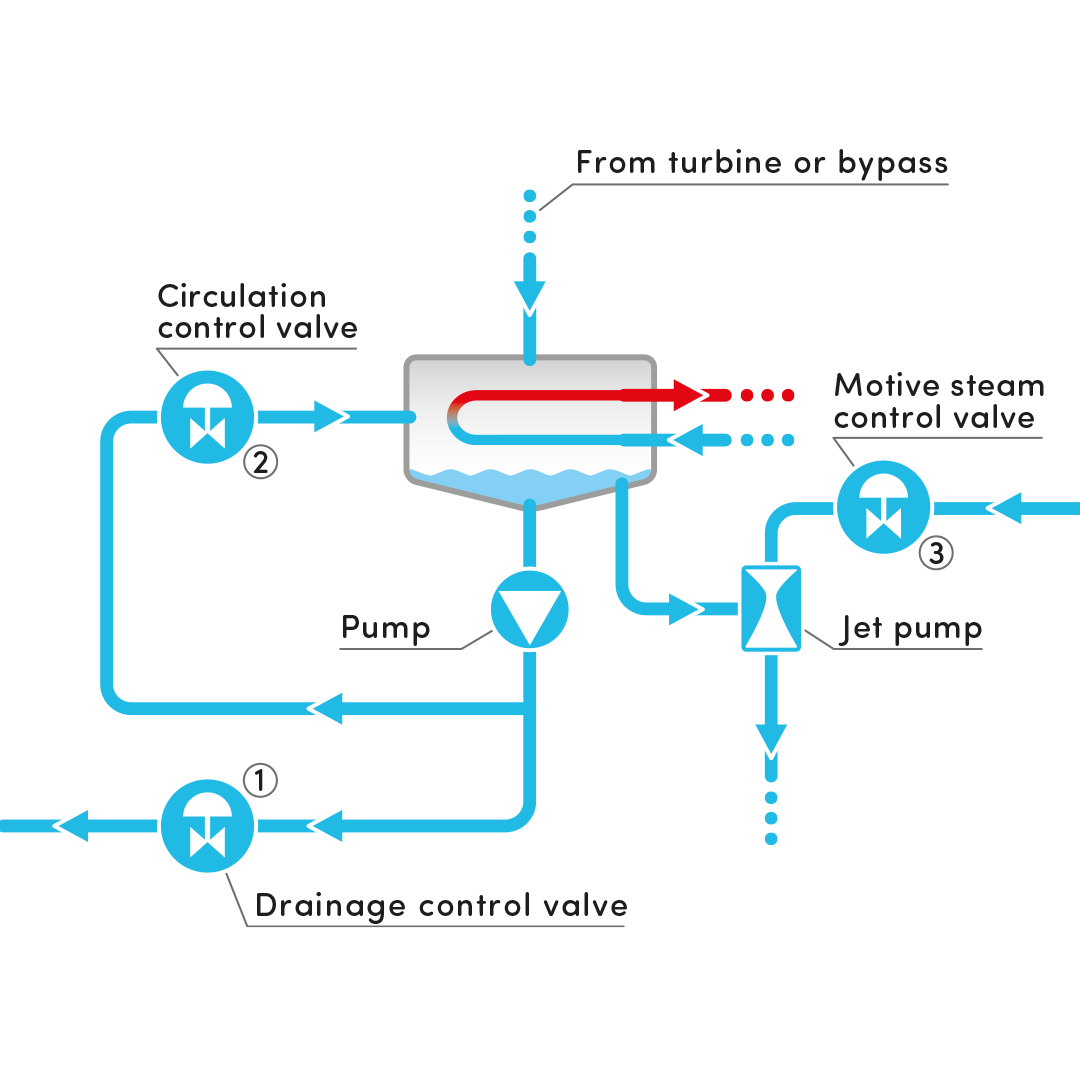
1) Con­den­sa­te drai­na­ge con­trol val­ve (va­riant I)

With the drainage control valve, the level in the condenser is controlled and the condensate is fed back into the feed water tank or a process line.

(Recommended : ECOTROL® Series 8C, 6H)

2) Con­den­sa­te cir­cu­la­ti­on con­trol val­ve (va­riant I)

The circulation control valve regulates the minimum quantity in the condensate pump bypass to prevent the pump from running dry. The stem seal of this valve must be vacuum-tight so as not to influence the under-pressure in the condenser, especially during start-up.

(Recommended : ECOTROL® Series 8C)

Com­bi­ned con­den­sa­te drai­na­ge & cir­cu­la­ti­on val­ve (va­riant II)

The aforementioned condensate drainage and circulation can be realized as well with a 3-way diverting control valve.

(Recommended : Series 200)

3) Con­den­ser mo­ti­ve steam con­trol val­ve

When starting up the system, as long as the turbine is not yet in operation, the vacuum in the condenser is generated with a steam operated-jet pump. The vacuum pressure control is determined by the motive steam control valve.

(Recommended : ECOTROL® Series 6N, 6H  and Series 190)

Feed Water Reservoir

You can find the suitable control valve for the feedwater tank in the power plant at ARCA.

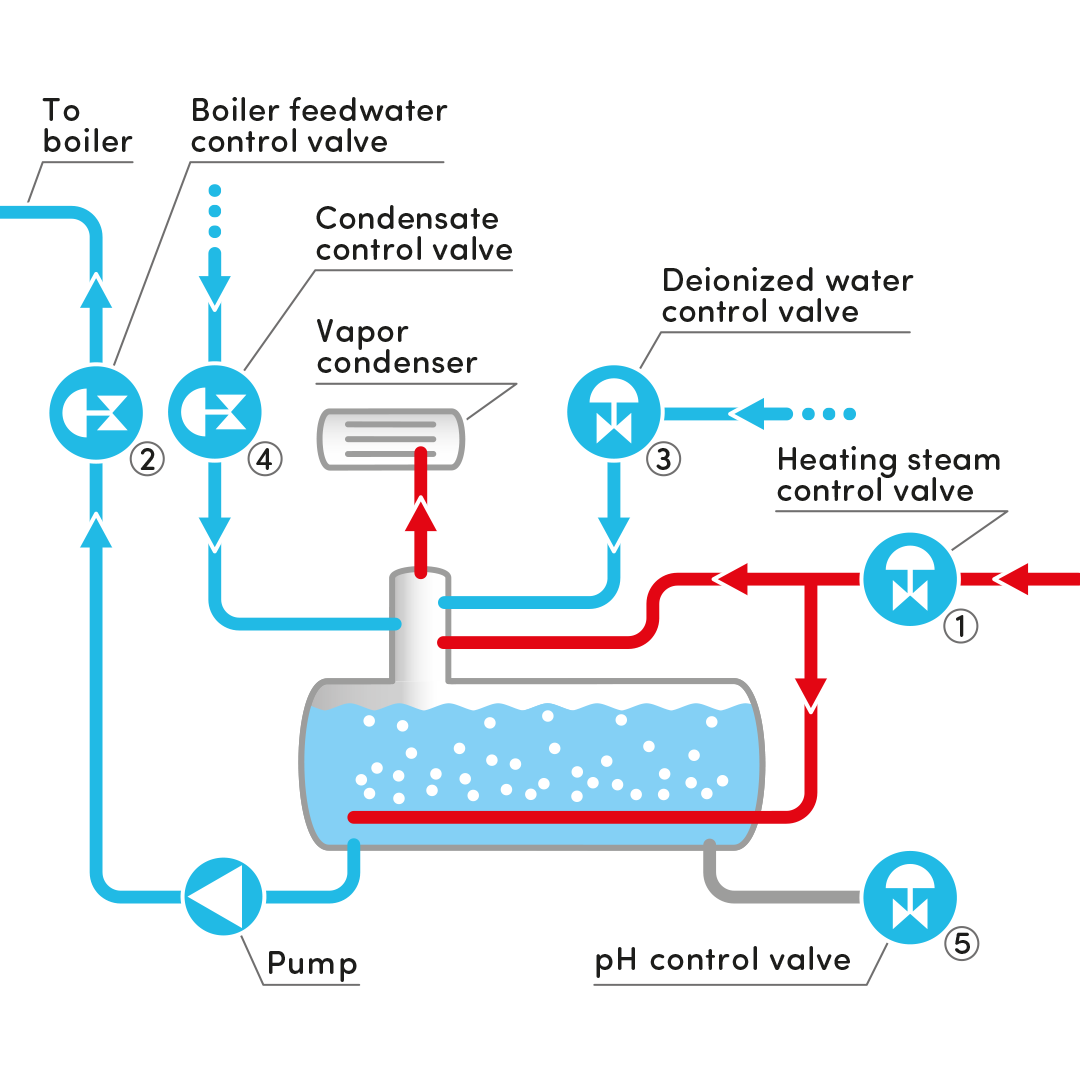
1) Hea­ting steam con­trol val­ve

The feed water is degasified in the degasifier, which is located on the feed water reservoir. As a result, the harmful gases oxygen and carbon dioxide are largely removed. The degasification of the feed water is mainly carried out at overpressure (p = 0.1 – 0.4 bar) and the corresponding saturated steam temperature of 102 to 108 °C. The feed water reservoir is heated by a steam lance in the water chamber for mixing the fluid and by adding steam in the gas chamber. The steam is supplied by the heating steam control valve, which must be provided with built-in noise-reducing components.

(Recommended : ECOTROL® Series 6N, 6H)

2) Feed wa­ter con­trol val­ve

With this control valve, the level in the boiler drum is regulated so that boiler feed water is continuously available in the boiler for steam generation. In order to compensate for the difference between the characteristic curve of the feed water pump and the operating characteristic of the boiler system, the feed water control valve must be designed accordingly.

(Recommended : ECOTROL® Series 8C, 6HSeries 350, 380)

3) De­io­ni­zed wa­ter con­trol val­ve

Losses are encountered in the water-steam circuit as a result of desalination, desludging, and sampling. These are compensated by adding deionized water from the water treatment plant. Impurities contained in the raw water in dissolved and undissolved form are removed in the water treatment plant. The deionized water is dosed to the feed water circuit by the deionized water control valve.

(Recommended : ECOTROL® Series 8C, 6H)

4) Con­den­sa­te con­trol val­ve

The condensate that accumulates throughout the entire plant is fed back to the water-steam circuit using condensate control valves. Subsequent evaporation may occur as the condensate expands, depending on the pressure and temperature, and must be taken into account when selecting the rated Cv value and nominal outlet diameter.

(Recommended : ECOTROL® Series 8C, 6NSeries 350)

5) pH con­trol val­ve

The pH value of the deionized water is controlled by adding ammonia or caustic soda enriched water from the ion exchangers in the water treatment plant. Today, this task is assumed primarily by metering pumps but can also be carried out using pH control valves.

(Recommended : ECOTROL® Series 8C)

Turbine

With us you will find the right control valve for every process step around the turbine of the power plant.

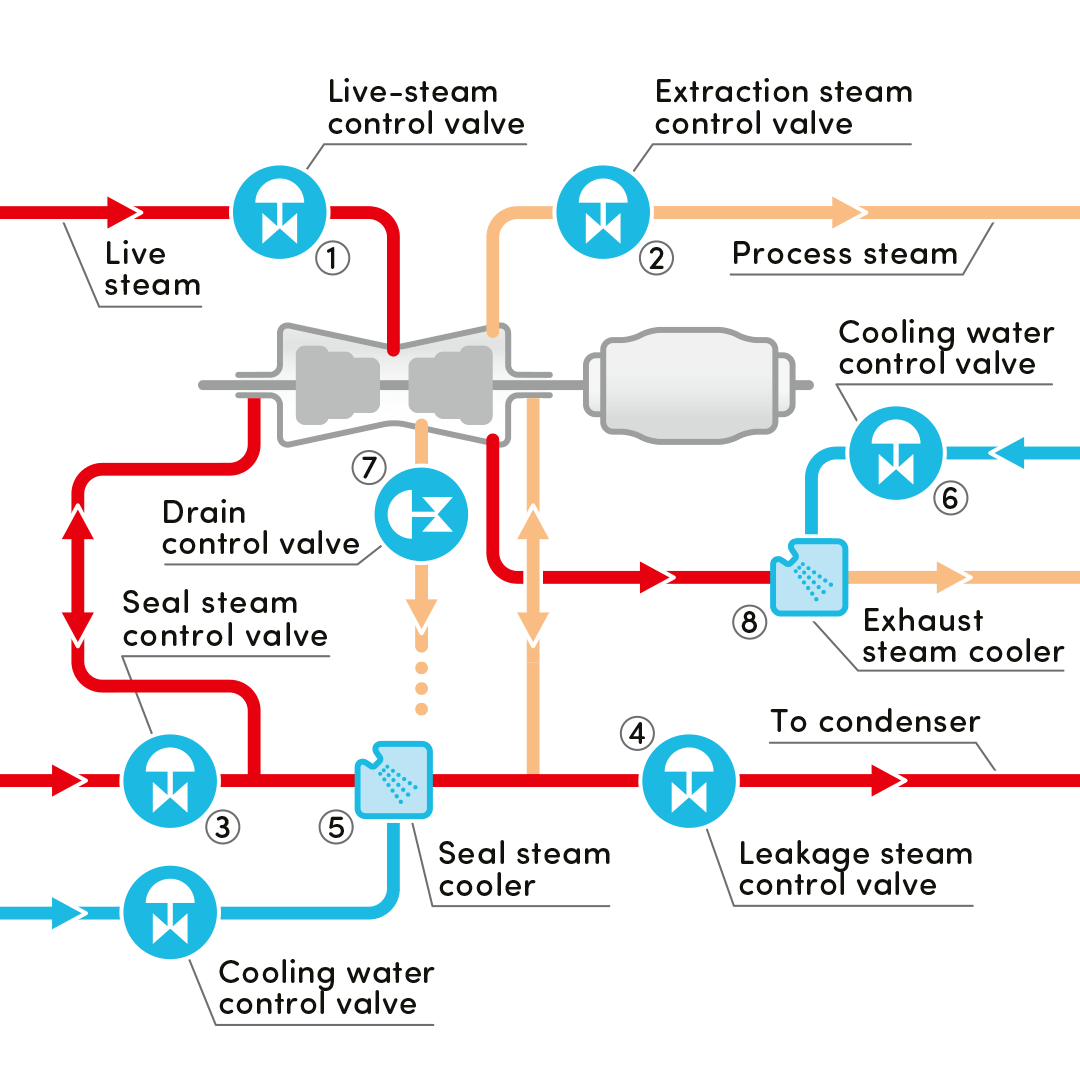
1) Live steam con­trol val­ve

This valve is used to control the pressure for the entry of the live steam into the turbine. Turbines for medium-sized heating and industrial power plants require straight-way and angle-control valves from DN100 to DN600 with fast response times.

(Recommended : ECOTROL® Series 6N, 6HSeries 350, 380)

2) Ex­trac­tion steam con­trol val­ve

This valve can feed the MP steam header to meet the power plant’s own requirements or regulate the pressure of process steam in industrial plants (e.g. paper mills) that frequently control multiple steam headers to supply a wide variety of heat exchangers. To this end, straight-way and angle-control valves (DN100 – DN600) with as large rated Cv value as possible for low differential pressure and a full stroke positioning time of less than 2 seconds are essential to tap the turbine with minimum energy loss.

(Recommended : ECOTROL® Series 6N, 6HSeries 350, 380)

3) Se­aling steam con­trol val­ve

The HP, LP, and MP turbine shafts of steam turbines are axially sealed with respect to the turbine housing by using labyrinth seals near the shaft throughput. The sealing-steam control system must maintain a predetermined low level of overpressure at the shaft labyrinths, regardless of load changes in the turbine or condenser. When the seal-steam pressure is too high, leakage steam from the shaft labyrinths can contact the bearing bodies via the oil-sealing rings and condense to water in the oil system. When the seal-steam pressure is too low, on the other hand, air can be taken in, which reduces vacuum pressure and further promotes the formation of condensate. The seal-steam control mechanism is designed to feed steam to the labyrinth chamber and purge accumulating leakage steam, depending on the type of turbine and the way it operates. Seal steam (typically live steam) is fed using the seal-steam control valve (DN15 – 100), which is often required to regulate in a very precise manner under high differential pressure.

(Recommended : ECOTROL® Series 8C, 6H and Series 190)

4) Le­a­ka­ge-steam con­trol val­ve

The conditions that prevail for the aforementioned valve apply here as well. Leakage steam is purged using the leakage-steam control valve (DN50 – 300), whereby the steam is extracted into the condenser vacuum behind the valve.

(Recommended : ECOTROL® Series 8C, 6N)

5) Seal-steam coo­ler

Live steam often has excessively high temperatures, especially at the shaft on the low-pressure side of industrial turbines. This can be counteracted with a mini cooler (DN65 – 150) or similar.

(Recommended : Series 595,596)

6) Coo­ling Wa­ter Val­ve

To control the temperature of the turbine, the cooling water (usually condensate) is supplied to the cooler with this valve DN15 – 50.

(Recommended : ECOTROL® Series 8C, 6H, Series 130, and Series 190)

7) Drain con­trol val­ve

All low points in the steam pipeline and turbine chambers must feed accumulated condensate to the condensate collector as the system warms up and during operation by way of an on/off or control valve.

(Recommended : ECOTROL® Series 8C, 6H, Series 130, and Series 190)

8) Ex­haust steam coo­ler

Exhaust steam from the turbine supplies the low-pressure steam headers (whose temperature is cooled by the exhaust cooler), depending on the type of turbine and the way it operates in industrial plants.

(Recommended : Series 590,596,597)

Turbine Bypass

Find the right control valve for your turbine bypass now at ARCA!

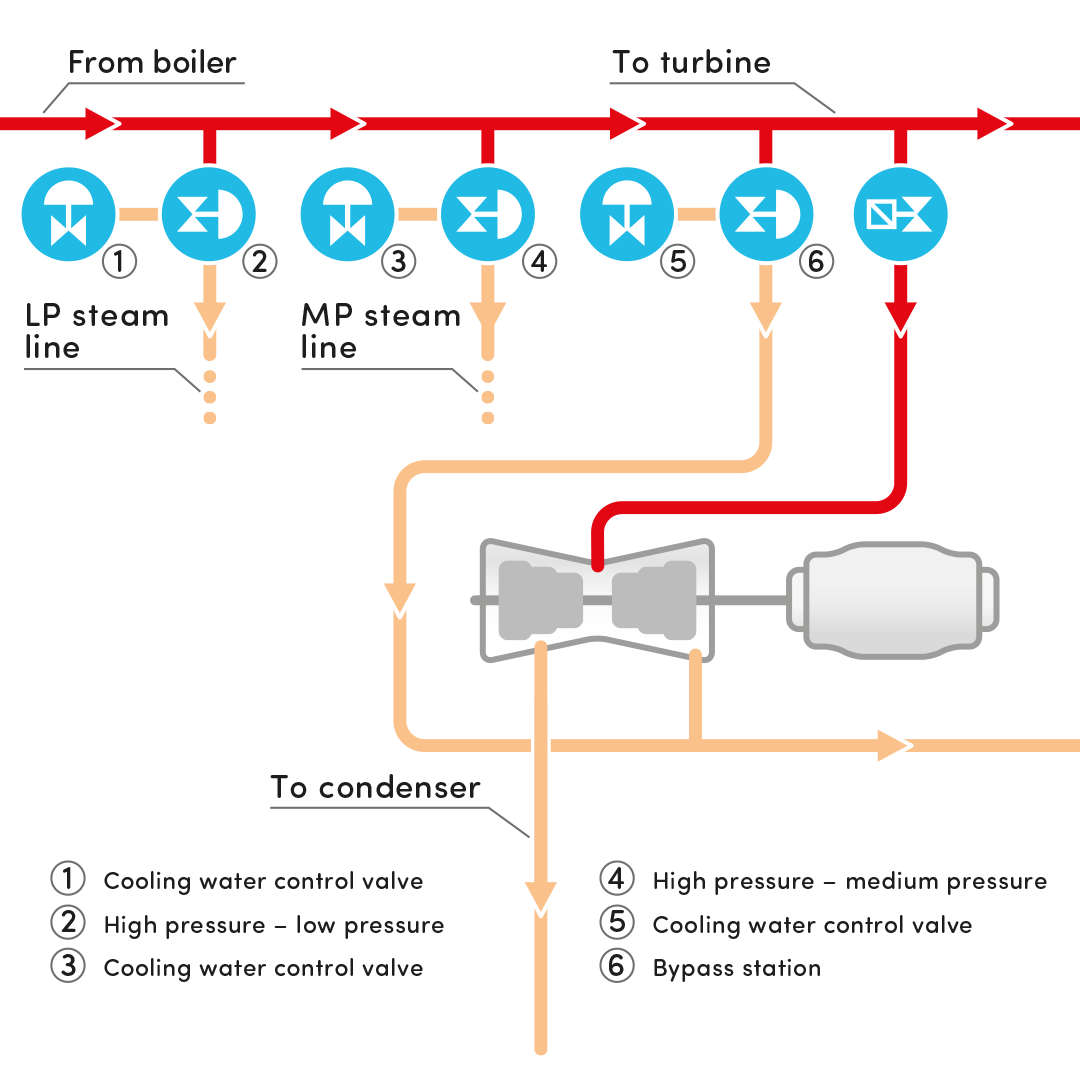
1), 3), 5) Coo­ling wa­ter val­ve

The temperature of the secondary steam downstream the steam-conditioning stations is controlled by the cooling water control valves and is feeding the cooling water chamber or nozzle of the steam-conditioning control valve.

(Recommended : ECOTROL® Series 8C, 6H and Series 190)

2) HP-LP Steam-Con­di­tio­ning Sta­ti­on

The HP-LP station supplies the plant with low-pressure steam to meet the power plant’s own requirements when the turbine is not running or turbine tap pressure is insufficient.  ARCA steam-conditioning control valves, which minimize noise as far as possible for humans and the environment by using multi-stage perforated plug and cage combinations, provide ideal conditions for this. Steam pressure is reduced in the valve and cooled by injecting cooling water into the valve itself or at the valve outlet with respect to the operating data.

(Recommended : Series 510 to 580)

4) HP-MP Steam-Con­di­tio­ning Con­trol Val­ves

The HP-MP station supplies the plant with medium-pressure steam to meet the power plant’s own requirements when the turbine is not running or turbine tap pressure is insufficient.  Otherwise, same remarks apply here as with the previously described valve.

(Recommended : Series 510 to 580)

6) By­pass Sta­ti­on-Steam-Con­di­tio­ning Con­trol Val­ves

The bypass station takes up the excess live steam and typically leads it through a steam tube directly into the condenser, especially if the emergency tripping mechanism for the turbine is actuated. Thus, fast and precise actuation times are required, since this is a safety device to protect the plant and to avoid the blow-off of steam into the environment.

(Recommended : Series 560 to 580)

Boiler

At ARCA you will find the right control valve for each process step in the boiler of the power plant.

1) Feed wa­ter con­trol val­ve

With this control valve, the level in the boiler drum is regulated so that boiler feed water is continuously available in the boiler for steam generation. In order to compensate for the difference between the characteristic curve of the feed water pump and the operating characteristic of the boiler system, the characteristic curve of the feed water control valve must be designed accordingly.

(Recommended : ECOTROL® Series 8C, 6H, Series 350, 380)

2) Feed wa­ter start­up val­ve

The boiler drum is filled by this control valve when the system is started up. Since a large differential pressure and cavitation have to be mastered during start-up, this valve is subject to high stress and thus wear. Therefore, this often small valve is equipped with a hardened multi-stage trim and is located in parallel with the feed water control valve, which must then be designed for maintaining the level.

(Recommended : ECOTROL® Series 8C, 6H, Series 190 and Series 350)

3) Bur­ner con­trol val­ve

This valve regulates the supply of natural gas to the gas burner or the fuel oil to the oil burner on the boiler. During gas operation, special attention has to paid on the flow characteristics and the noise reduction. During fuel oil operation this valve operates as a back pressure control valve keeping the pressure upstream of the oil burner constant.

(Recommended : ECOTROL® Series 8C, 6N)

4) Blow­do­wn val­ve

This valve quickly opens for a brief moment to drain a small quantity of boiler feed water for desludging the boiler water drum. Hard internal parts are required to withstand the high differential pressure, flashing conditions and abrasion that prevail. The sealing edges of this control valve are subject to wear, which is why we recommend installing an additional shut-off valve here.

(Recommended : ECOTROL® Series 8C, 6H, Series 190, Series 350, 380)

5) Boi­ler start-up con­trol val­ve

The start-up control valve typically blows steam through a silencer system into the atmosphere when the boiler is started. Since the steam expands with a high pressure reduction, this valve usually has an asymmetric design.

(Recommended : ECOTROL® Series 8C, 6H, Series 350, 380)

6) Soot blo­wer con­trol val­ve

The walls of the heat exchangers in the boiler are steam-cleaned of soot particles to optimize heat transfer efficiency inside the boiler. To this end, soot blower control valves feed live steam to the soot blower nozzles with minimum actuating time. (series: 6H, 190, 350, 380)

(Recommended : ECOTROL® Series 6H, Series 350, 380)

7) Air prehea­ter con­trol val­ve

The burner air is preheated to optimize the effectiveness of the combustion process. The temperature of the burner air is determined by the steam fed to the air preheater via this control valve.

(Recommended : ECOTROL® Series 8C, 6N)

8) 3-way mi­xing val­ve (va­riant I)

Superheating the steam of the steam turbines while they are running increases plant efficiency and prevents the turbine blades from becoming damaged by condensed drops of liquid. For better energy utilization of the generated steam, a secondary superheater is installed in power plants with higher steam pressures. The heat transferred to the superheater varies greatly due to fluctuating loads and soot deposits in particular. The temperature of the superheater must therefore be regulated. The superheated steam is passed through a pipe coil by means of the 3-way mixing valve, which is located in the water-filled part of the steam drum. The colder drum water with the saturated steam temperature thus cools the superheated steam. (series: 200, 220)

(Recommended : Series 200,220)

8) Boi­ler in­jec­tion coo­ler (va­riant II)

Another way of controlling the superheater temperature is usually implemented in new systems by injecting boiler feed water with a desuperheater.

(Recommended : Series 590)

Scan the code